As an arena for public use and social interaction, public spaces are most often developed, managed and maintained by municipal government. If the municipal government adopts a people-centered approach to urban planning, they will more effectively achieve sustainable development. Emphasis needs to be placed on a shared responsibility between community and private entities with regard to the localized planning and maintenance of public space.
2. Inclusive public space for all, particularly vulnerable groups
Attention needs to be given to vulnerable members of the population, including the elderly, the disabled, youth, and low income groups, to ensure their social and political inclusion in the allocation and design of public spaces. Public space has a responsibility to be flexible and open enough to serve a variety of users and uses, ranging from informal to formal settlements. Well-designed public spaces not only contribute to improve the visual and spatial character of a city, but also stimulate and enhance intergenerational, social and economic activities.
3. Public space that respects human scale and behavior
All public space needs to be of a human scale and respond to a variety of functions and patterns of use based on an understanding of human behavior, health, needs, sensibilities and aspirations. Spaces are defined by their shape and the quality of their edges. Simple temporary and tactical interventions can test and promote more permanent changes.
A holistic, evidence-based approach to the city is necessary with attention focused not only on the space itself, but its form, function and connectivity. Streets should serve as multimodal networks of social and economic exchange, forming the urban framework of interconnected public space. Walkability, social interaction, multimodal mobility and accessibility should be supported by a fine-grained block and street network lined with buildings providing amenities and services with a mix of uses and sizes.
5. Economic productivity of public space
Investing in public space can have powerful social, economic, cultural and health benefits. If people are committed to their future in a specific place, they invest more time and capital in that place, which has a positive impact on the local economy and creates a virtuous cycle of economic growth. Public space stimulates the small scale, local and informal economy, as well as generates tax revenue.
6. Access to public space – public and private spheres
In many places there has been a reduction of urban public space, a lack of clear boundaries between the public and private spheres and diminished freedom of expression and movement. The market alone cannot always provide a variety of public and private open spaces. A more nuanced range that provides a variety of open places, including semi-public and semi-private space is needed.
7. Sustainable public spaces that are healthy, safe, resilient, energy-conserving and resource efficient
Public space and the buildings that surround and define it need to be socially, economically and environmentally sustainable. Social sustainability requires security, equity and justice; economic sustainability benefits from affordable capital and operating budgets; environmental sustainability addresses ecological and health issues. These include clean air, water and soil, green micro-climates and the mitigation and adaptation to the Urban Heat Island Effect and Climate Change. Effective use should be made of green technologies and systems. Architecture and urban design that is adaptable and appreciated is cared for and sustained for a longer time.
8. Culture and context of public space
Public space is made unique through cultural and contextual elements that complement and enrich its identity. Spaces should be flexible and respond to the geography, climate, culture and heritage specific to its locality. Public arts can be an effective method for celebrating community identity and belonging in open spaces.
Action and Implementation:
There is a need for action and implementation mechanisms that support and protect public space and its users.
Advocacy and Mobilization Raise awareness and create movements to mobilize stakeholders in the pursuit to build community. Promotion of discussions, forums, workshops, pop-up projects and public space prizes will further mobilize and increase awareness of and sense of belonging.
Measurement and Monitoring Establish policy and frameworks at the national level for cities to allocate an appropriate percentage of the land to public space. An inventory of public space assets in a city will reveal the availability of public space typologies, allowing city-builders to address shortfalls and encourage a balance of public spaces throughout a city.
Public Space Financing Solutions Examination of creative financing solutions such as public land acquisition, conversion of private space to public space or land value capture will be effective in producing greater amounts of economically sustainable public space.
Policies and Legislation for Public Space Establish policies, legislation, and regulatory mechanisms for the provision, design, management and use of public spaces. Long-term structures, management mechanisms and partnerships at the national, regional and local level can align governments and other stakeholder’s interests. Open feedback and accountability mechanisms can ensure two-way discussions among stakeholders.
Empowerment of Marginalized Groups Set in place processes for the inclusion of all ages, the vulnerable, and the disadvantaged. Establish a legal framework to ensure the inclusion of disadvantaged groups in public space discussion and processes. Special emphasis should be placed on job creation, livelihoods and quality of life for low-income groups.
Tools and Knowledge Management Establish open-source knowledge management platforms with training workshops, capacity building, tools, best practices, model legislation, statistics, and methodologies for creating and managing public space. Empirical evidence-based research on the practice and theory of public space needs to be made widely available.
Climate Change Centre Reading – CCCRdg strongly advise Reading Council to enroll the green process to become a sustainable place, get on-board the European Green Capital Award! More than 1000 grassroots organisations in Rdg would back the council in forming first non-dividend post-carbon economy net-borough. Every missed opportunity adding up to #climatechange. It is #TimetoAct.
Where’s Reading Heading #wrh Rdg CAN!
– Have a well-established record of achieving high environmental objectives.
– Commit to ambitious goals for future environmental improvement and sustainable development.
– Inspire other cities through new ideas, best practices and experiences.
The Commission has launched the search for the 2018 European Green Capital. The award is given to a European city that has demonstrated a well-established record of achieving high environmental standards and is committed to ongoing and ambitious goals for future sustainable development. Cities across Europe with more than 100,000 inhabitants are eligible to apply for the title. ?#?EUGreenWeek? Find out more here:http://ec.europa.eu/…/eur…/launch-of-the-2018-egc/index.html
African Development Bank – Election of the President: Statement by Cristina Duarte, Minister of Finance and Planning, Republic of Cape Verde
“Our agenda should aim at ending the management of poverty to focus on the creation and better management of resources in Africa” ??- Cristina Duarte
ABIDJAN, Ivory Coast, May 29, 2015 / African Press Organization (APO) /– Statement by Cristina Duarte, Minister of Finance and Planning, Republic of Cape Verde ( http://www.minfin.gov.cv ):
Dr. Akinwumi Adesina, Minister of Agriculture of Nigeria, was elected May 28, 2015 as the future President of the African Development Bank (ADB). I congratulate him and his country.
At the same time, I want to thank all the governments and peoples who have supported my candidature for this competition. It is with humility that I received your support. The same inside me when I started this race. I also thank my compatriots and the government of my country brought me to this position. I would like to thank of course the various candidates who took part in this democratic and transparent process that has enabled Africa to show the way forward. This is a victory for Africa.
It is now time to return to work. As a pan-Africanist, I will continue to be engaged in the causes of Bad and contribute within the limits of my ability to support its new President as well as to push for the necessary reforms to ensure nature of our bank has the catalyst status for the transformation of Africa.
This will require that we strengthen the progress made over the last 50 years while taking into account emerging issues. In this regard, we must build a bank based on merit, having an intense focus on results and development impact, effectiveness and efficiency as a record dialogue and provision of quality advice to African governments. The African Development Bank must become innovative and we must rely on the ability of the bank to be a capacity-sharing partners and force-party stakeholders, including African governments, development agencies and partners private sector, commercial banks and civil society. This is set to face the great challenges of our time on regional integration, strengthening the status of women, the promotion of science and technology, issues of insularity, climate change or the fragility of States.
In sum, our agenda should aim at putting an end to the management of poverty to focus on the creation and better management of resources in Africa. In this regard, I will devote a significant part of my energy to contribute to ensure that the aspirations of a billion Africans for a new African dawn, a continent at peace with himself, who participated in the global competition on a level equality with other actors, an Africa able to take charge, make this a reality!
Long live Africa! God bless Africa!
Cristina Duarte
Minister of Finance and Planning
Republic of Cape Verde
Distributed by APO (African Press Organization) for the Ministry of Finance and Planning, Republic of Cape Verde.
Over Christmas I had a interesting conversation that got me thinking. I was chatting with someone about climate change, and we agreed on a lot. They accepted the science, and understood that it spelt disaster for future generations. But we differed on one crucial point: whether we could actually do anything about it.
Climate catastrophe is inevitable, they said, because governments would not take meaningful action to cut carbon emissions. They ‘couldn’t see the point’ of the global climate marches in September, because politicians ‘wouldn’t listen’. It was ‘too late’ for us to do anything about it, because we’d just be ‘moving deckchairs on the Titanic.’
In my view, this is the most dangerous type of climate scepticism there is. The flat-earthers who question the science are becoming increasing irrelevant, and the ‘no-alternative to fossil fuel’ crowd are seeing their arguments weaken with every new solar panel or wind turbine installed. But what do you say to someone who acknowledges the problem but simply doesn’t believe in the solution?
I can think of three reasons why someone might believe that climate change is inevitable. Firstly, they might think we’ve already burned enough fossil fuels to lock in climate catastrophe. Secondly, they might believe the technical solutions are beyond us. And thirdly, they may believe that while we have the technical capacity to avoid climate change, we lack the political agency to force the issue onto the agenda. All three are wrong.
Let’s start with the idea that we’ve already emitted too much carbon. To force 2C of global warming, the internationally agreed (and heavily contested) limit for ’safe’ global temperature rise, we’d need to release approximately a trillion tonnes of carbon into the atmosphere. But if you look at how much carbon we’ve actually emitted, you find we’ve released 60% of this amount. At current emissions rates, assuming we don’t cross unpredictable tipping points beforehand, we won’t technically be ‘too late’ to avoid dangerous climate change until September 2039, when we’ll release the trillionth tonne of carbon. And if we cut emissions by about 2.6% a year, starting today, we’d never reach that limit at all.
What about the argument that while we can cut emissions in theory, we don’t have any viable alternatives? Well, the latest report from the IPCC looks at precisely this question, and concludes that a transformation to clean energy is not only possible, but can be achieved without any dip in living standards. This is important, because one of the barriers to people supporting climate action is the mistaken belief, propagated by climate deniers, that a sustainable world will mean giving up modern life.
The IPCC shows this to be the nonsense it is. The report found we could completely abandon fossil fuels by transitioning to a cleaner mix of solar, wind, hydropower, nuclear, and biofuels while improving energy efficiency. So a sustainable energy revolution is entirely possible, and what’s more, it wouldn’t even cost that much: the report found the necessary investment would trim just 0.06% off annual economic growth rates.
But this rosy scenario comes with comes with a big caveat. None of this will happen without a significant shift in political momentum, which brings us to the third cause for climate pessimism – the idea that, even if we accept we have both the time and the tools to transform the global energy system, our politicians will never make the commitments required.
After all, for governments working on five-year election cycles, tackling threat of climate change is a nightmare – the issue is remote in time and space, impersonal, requires unprecedented international cooperation, costs money, and delivers no immediate benefits to the electorate. When you add in the immense pressure exerted by the fossil fuel lobby to maintain the status quo, you begin to see how the single most pressing issue facing humankind has remained at the bottom of the political to-do list.
But it doesn’t have to stay there, because in the world’s growing number of democracies, politicians are bound by public opinion: they can only ignore us if we fail to build the critical mass required to turn tomorrow’s climate crisis into today’s political hot potato. If we accept that man-made climate change is the threat the science tells us it is, and that politicians aren’t doing enough to counter it, it follows that must ask ourselves a simple question: have we taken political action to bring us closer to a solution?
If everyone who believes that the British government isn’t doing enough on climate change (78% according to this poll) were able to answer yes to this question, the issue would be at the top of the political agenda. So we face a choice: we can stay locked in the learned helplessness of political disengagement, afraid that our voices won’t be heard, that our fears for the future do not count, and be proven right by our own apathy. Or we can get out there and start doing something.
Abraham Lincoln, a man with a better grasp of politics than most, once observed: “With public sentiment, nothing can fail; without it, nothing can succeed.” In other words, we’ll get the politics, and the future, we deserve. A better world only becomes possible when we believe it is.
In August 2014, Reading Museum secured a second round of funding from the Happy Museum Project.
Our new project, ‘Where’s Reading Heading?’ looks at the past, present and future development of Reading. It seeks to provoke debate about how Reading will sustain a growing population and build a successful low carbon economy whilst ‘Narrowing the Gaps’ between different sectors in our communities.
Current work being led by the University of Reading, Reading UK CIC and Barton Wilmore, through the Reading 2050 initiative, envisages a smart and sustainable future for Reading. This will involve communities coming together to influence how the town will evolve in the decades ahead.
To promote debate the Museum asked Russell Alsop of local production company Ginger & Pickles to make a short documentary film, drawing together the views and knowledge of a widespread group of Reading people. This has included school pupils, academics, local politicians, business people, ecologists, architects, and residents from our local neighbourhoods.
As part of the project, radio style interviews were conducted. Within them are many views and learnings from experts and active citizens which enabled the film-maker to shape the documentary. You can listen to these on the museum’s SoundCloud (follow the link at the bottom of the page).
We hope our ‘Where’s Reading Heading’ film may encourage you to get involved.
The organisations that took part in the film-making process include:
Reading International Solidarity Centre (RISC)
Berkshire Local Nature Partnership (LNP)
Greater Reading Environmental Network (GREN)
Nature Nurture
Reading Climate Change Centre
Reading Sustainability Centre
Reading Voluntary Action (RVA)
The Walker Institute, Reading University
Each of these local organisations provides opportunities for Reading residents to become active in initiatives influencing Reading’s future environment. Click on the links below to go to their websites and find out more – the LNP and GREN sites also include directories of other local groups.
I’m an optimist from a long line of problem solvers, I was brought up with the mindset that there is no problem too big to fix so even if at first something seems overwhelming you might as well have a go at solving it. This is the case with climate change, the majority of people I know are aware of climate change but it seems like a distant problem and they feel like they can’t contribute enough to solving it so don’t do anything. So what motivates me?
The things which motivate me can be placed under two categories: fear and hope.
FEAR
The fear category represents all the things that I as an individual don’t want to be destroyed by a failure of our species to act on this and other environmental issues. As an Ecologist I’m passionate about protecting the other species on this earth but also very aware of how much we depend on biodiversity to provide us with food, energy, materials for goods and services, space to feel free, buffer us from extreme weather events and turn our waste products back into clean water and nutrients which fertilise our soils. Biodiversity is key to providing these services as this helps maintain ecosystems which can react to changing conditions. However due to a combination of habitat loss and climate change impacts the forecasts for the health of the world’s ecosystems under the business as usual scenario aren’t great. If we don’t swiftly reduce our greenhouse gas emissions it is highly likely that 2/3 of vertebrate species alive today will be extinct be the end of this century. This translates into reduced crop yields, altered rainfall patterns, dead fisheries and broken ecosystems Many of the keystone species which help maintain the conditions for our civilisation to thrive will be gone and we’ll gain the title of the first ever species to have evolved on this earth to have knowingly caused a mass extinction and not done anything about it.
Of relevance to Britain is how the Amazon fuels the weather systems which provide our rainfall, currently the Amazon acts like a giant humidifier. Trees pump water vapour into the atmosphere via a process called transpiration. Much of this is recycled within the Amazon itself falling as rain or mist soon after being transpired by the trees but a hefty proportion of it is swept in our direction by the air currents associated with the gulf stream to provide much of our rainfall. IPCC models predict that if warming proceeds much beyond 3°C the Amazon rainforest will go dry and disappear in a very big puff of smoke, with it an important source of rainfall that is vital for agriculture throughout Europe.
I’m currently in my mid twenties and I’m very conscious that if unabated the impacts of climate change will be in full swing by the time I retire. I want to pass on a healthy world to future generations and I don’t fancy explaining to my niece and nephew why we failed to act. I recognise that this is no mean feat. To avoid dangerous climate change we need to leave 70-80% of known fossil fuel reserves in the ground and promote regeneration of the world’s forests to help sequester the carbon that is already in the atmosphere.
HOPE
Hope represents my vision for a more sustainable, zero carbon world. For the UK this means aiming to go zero carbon by 2035. Based on the 3000 people who showed up to the Edinburgh People’s climate march last September along with the millions who hit the streets globally this is a vision I know I share with many others. A zero carbon society means cities free of smog and traffic noise, a healthier more active population, well insulated warm homes, thriving communities empowered by the chance to take ownership of their own food and energy production reducing our dependence upon other nations for our energy needs and healthy ecosystems allowing wildlife to thrive while providing space for us to play and relax.
There are also glimmers of this society emerging: recently the Economist reported that 2014 was the first non-recession year in which global carbon dioxide emissions flat lined due to a move away from coal, the divest from fossil fuels movement is gaining momentum as large institutions such as the Rockerfeller group and Glasgow University move their money out of fossil fuels, countries and cities all over the globe are spawning a renewable energy revolution with Scotland on track to meet its target of 100% renewable electricity generation by 2020 and people are organising to drive change from the bottom up.
That said the risk still remains that governments and corporations with vested interests in an economy addicted to fossil fuels will stifle change. For example in the UK the recent discovery of vast quantities of oil in South East England represents a major decision we have to make about the kind of future we want to create, for many it represents a line in the sand that we simply should not cross as exploitation of this resource would lock us into oil dependency for more years than we can afford. Globally big oil companies like Shell are pushing further and further into hostile regions such as the arctic to access previously marginal oil reserves. An oil slick in this region would devastate the arctic ecosystem and seriously impact fish stocks relied upon by millions of people.
SO WHAT DO WE DO?
I don’t have all the answers but together we do, this is no longer an issue of technology. We’re an intelligent species and already have the tools and technology to create the zero carbon society that so many people want it is simply an issue of will. The most powerful thing anyone can do is organise, link up with others in your community working on climate related issues whether it’s growing food locally, campaigning to pressure governments and companies to change their practices, creating renewable energy schemes, reducing waste or working to build sustainable homes. It is likely that someone in your community is already active in doing something and would love a helping hand.
Although 2015 is a big year as far as global climate negotiations are concerned and we should pressure the UNFCCC to deliver when it comes to the talks in Paris this December the track record over the previous 20 years makes it clear that we can no longer pin our hopes on the efforts of world leaders to take action for us. We need to take ownership of this issue and work together to make our own villages, towns and cities sustainable. In Edinburgh a new coalition has emerged in recent months under the banner of the people’s climate movement. We aim to provide a platform to unite and motivate all local groups, businesses and organisations acting on climate change to drive Edinburgh and surrounding communities zero carbon by 2035 and we are making progress.
SO WHERE CAN I START?
If you can make it to Edinburgh on Saturday May 23rd there will be a People’s Climate Assembly designed to inform inspire and equip attendees with the tools and knowledge to organise and act on the climate change issues that they are passionate about. For more information please contact peoplesclimateedinburgh@gmail.com.
If you can’t attend then a simple internet search will likely yield results, contact your local Friends of the Earth , Transition towns or Greenpeace group. They’ll likely have contacts and links to local projects you can get involved in from direct action to community energy projects you can invest in.
As I said at the start, I’m an optimist I am confident that we as a species have the potential to secure our future by preserving rather than trashing this little blue and green dot we call home. I’ve been inspired by the recent buzz around this issue. I’d much rather reach old age and tell stories to my Niece and Nephew about how we worked together to protect our environment for future generations than how we failed to act. If we allow ourselves to succumb to despair then we will fail but if we act and organise then we may just pull it off so let’s give it a go eh?
Jethro Gauld
MSc Ecosystem Services, BSc Ecology and Conservation
Leader of the Edinburgh RSPB Phoenix group for teenagers aged 11-16 interested in wildlife, GIS Technician for Scottish Water and active participant in the Edinburgh People’s Climate movement.
COUNCIL NEEDS TO BE ’SERIOUS’ ON AIR QUALITY
Green Party are grubby and gimmicky, says Cllr Page Reading Midweek, April 15 2015 Carly Read
A COUNCILLOR has claimed that reading borough council is “burying its head in the sand” after Friday saw air pollution reach levels so high that the government issued a health warning to residents with heart and lung conditions.
High air pollution across the borough last week resulted in the Department for Environment, Food and Rural affairs warning adults and children suffering from asthma and those receiving care for heart and lung problems not to take on strenuous activity.
And with more air pollution set to hit the Borough tomorrow (Tuesday), Green Party leader Rob Wite said the council should be doing more to tackle the problem.
He said: I think the council need to really try harder to tackle the problem.
He said: “I think the council need to really try a lot harder and do more to make people aware of the invisible killer that is air pollution.
“I think we’re in danger as this problem becomes more prominent in the borough, so the council need to stop burying their heads in the sand because it´s not something that is going away.”
But reading Borough Council´s lead member for strategic environment, planning and transport, Councillor Tony Page claimed the idea of a text alert was nothing more than a “gimmick”
He said: “Rob Wite is talking absolute rubbish, it´s just nonsense. The green Party in Reading are a bunch of grubby little politicians and in fact are the ungreenest of green.
They´re hypocrites because the council is trying to push and promote a more environmentally friendly borough through things like Park and Ride and the greens are opposing these plans and criticizing them for being harmful to the environment.
He added: “The idea of text messaging residents to warn them of air pollution is just a gimmick – a gimmick from the gimmicky Greens – and I can tell you with all confidence that what people want to see is concrete measures put in to place and that´s exactly what we have.”
The council owns three road side units, in Caversham Road, King Road and Oxford road where air pollution data is collected and monitored.
The new warning for this week, issued on Monday morning encourages those at risk, including the elderly, to reduce outdoor activity until normal air levels return on Friday.
We’ve grown good at making many things in the modern world – but strangely the art of making attractive cities has been lost. Here are some key principles for how to make attractive cities once again
In “How to Make an Attractive City,” a new video from the School of Life, London-based Swiss writer Alain de Botton offers a cheeky, thought-provoking, six-point manifesto on the need for making beauty a priority in urban architecture and design.
The water was born, and water was, the great city of tenochtitlan.
Dykes, bridges, acequias, channels: Through the streets of water, two hundred thousand canoes were going and they came in between houses and squares, temples, palaces, the markets, the gardens, the floating plantíos.
The conquest of Mexico started out as a war of the water, and the defeat of the water announced the defeat of everything else.
In 1521, Hernán Cortés put site to tenochtitlan, and the first thing he did was break me with blows of axe the Aqueduct of wood I had, from the forest of chapultepec, water to drink. And when the city fell, at the end of a lot of killing, courteous sent demolish its temples and palaces, and threw the rubble to the streets of water.
Spain is wearing wrong with the water, it was a thing of the devil, heresy
Muslim, and water up was born the city of mexico, raised on the ruins of tenochtitlan. And continuing the work of the warriors, the engineers were blocking with stones and lands, in the course of time, all the circulatory system of Lakes and rivers of the region.
And the water took revenge, and several times flooded the colonial city, and that did not do more to confirm that she was an ally of the Indians pagans and enemy of the christians.
Century after century, the world dry continued the war against the world wet.
Now, the city of Mexico dying of thirst. In search of water excava. The more excava, more is sinking. Where he had air, there are dust. Where he had rivers, there are avenues. Where he ran the water, run cars.
BerksCAN – Time to Act
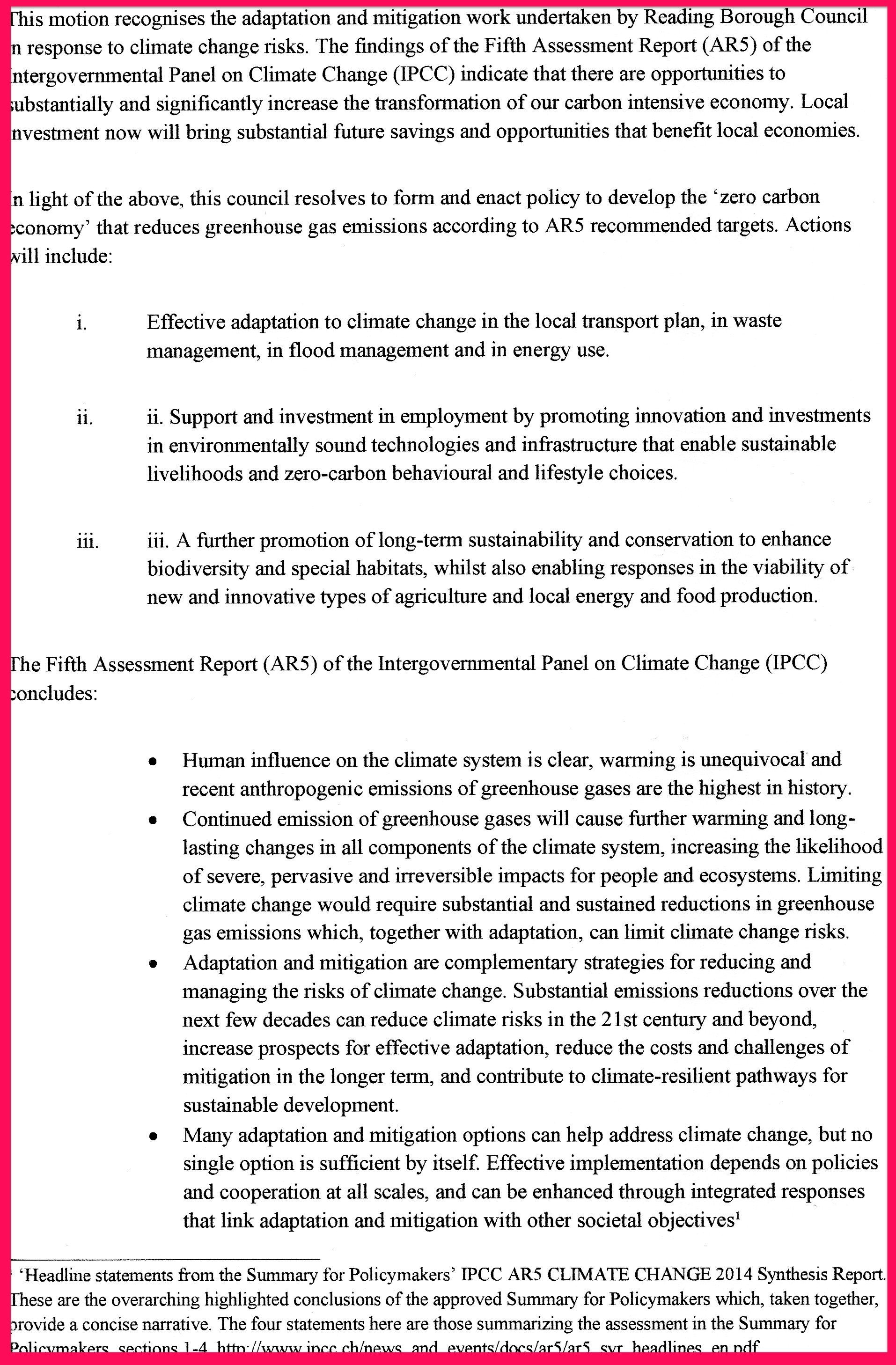
Climate Change Motion to Berkshire Borough Councils
Last month there was agreement by the Liberal Democrats, Labour and Conservatives to act on climate change irrespective of the result of the election, the pact is here :
Given the national climate change pact we would hope that our local leaders, irrespective of political party, will support the motion and a post-carbon agenda for Berkshire and ensure that dealing with climate change is a high priority now and beyond the election.
Please help support this motion by sharing widely and writing to your local political representatives to encourage their support. Open the Motion in .pdf-format here
Climate Marches
After a record turn out during the international Climate Marches on 21st September, where 410,000 turned out in New York, 20.000 in London and 700,000 globally, an update on climate progress seems appropriate.
New IPCC Synthesis Report
This week the world received another vital report from a large number of the world’s leading scientific experts on climate change – a report accepted by the UK government.
The report is available for download here and the press conference can be viewed here
The scale of the expertise on this report alone extends to the involvement of scientific experts from 85 countries with 800 authors and thousands of reviewers completing comprehensive reviews on over 30,000 peer-reviewed scientific papers on all aspects of climate change.
The 40th meeting on the issue by the IPCC assembled the Synthesis Report on the most recent findings, predictions and interpretations of data. This is no superficial institutional presentation but one which took six years of intense scientific study.
The report clearly tells us:
• Human influence on the climate system is clear and warming of the climate system is unequivocal – Recent man-made emissions of greenhouse gases are the highest in history.
• The atmosphere and oceans have warmed, snow and ice reduced, sea level has risen, the oceans have become more acidic and extreme weather events have intensified.
• Without substantial and sustained reduction in carbon emissions global temperatures by the end of the 21st century could be more than 4 °C above pre-industrial levels.
• A change of that size would very likely lead to severe, pervasive, and irreversible impacts on societies and the environment globally.
• Snow, ice, permafrost and glaciers are melting at the poles and globally.
• The oceans are becoming increasingly acidic.
• Extreme weather events are changing. Heat waves are lasting for longer and becoming more intense, and heavy rainfall events are becoming heavier.
• Trees and forests are dying back, corals declining, and animals have shifted from their natural habitats.
• Man-made emissions of greenhouse gases have risen enormously since the industrial revolution; CO2 levels are now at their highest in at least the last 800,000 years.
• Much of this rise in emissions has occurred in the last 40 years, with current emissions the highest in human history.
• Heat waves will occur more often and last longer, increasing the risk to health
• Heavy rainfall events will become heavier and more frequent in many places
• The ocean will continue to warm and acidify, negatively affecting marine wildlife and fisheries.
• Global average sea level will continue to rise, disrupting communities due to coastal flooding from storm surges.
• Food security will be undermined as changes in the oceans affect fisheries and drought and rising temperatures reduce global crops yields.
• To have a chance of keeping temperature change below 2 °C by the end of the century, global greenhouse emissions in 2050 need to be 40 to 70 % lower than in 2010, and emission levels near zero or below in 2100.
• Climate change will amplify existing risks and create new risks for natural and human systems. Continued high emissions would lead to mostly negative impacts for biodiversity, ecosystem services, and economic development and amplify risks for livelihoods and for food and human security.
• This means we need total human emissions of CO2 to remain less than 2900 GtCO2. We have already emitted 1900 GtCO2, which is about two thirds of this limit.
• The longer we delay action, the harder and incredibly more expensive it will be.
• The Synthesis Report provides a strengthened case for international leaders to act now to reduce domestic carbon emissions and to secure an ambitious legally binding global agreement in 2015.
Settled Scientific Advice
We need to heed the scientific advice. It is the IPCC professionals – who have often dedicated their whole lives to understanding the complex science of our finely balanced ecosystems and atmosphere – whose advice we should act upon.
Fortunately many politicians are sensible enough to know when they too need to take advice on policy-making from the right experts and so most align with the IPCC recommendations to some extent. Yet some of our UK politicians claim to know more than all those IPCC experts put together! How absurd that we give them the time of day, when they put our world at risk by hindering and delaying action to reduce CO2(e).
As Prince Charles adequately put it: “we should compare the planet under threat of climate change to a sick patient. No doctor would wait for 100% certainty whilst a dying patient slipped away.” In this scenario the doctors are the IPCC, who have over 95% certainty, and just as a doctor would not ignore the symptoms before something irreversible happens neither should we – we must act now.
Crucial UN Climate Maeeting – COP21 Paris
We have the UNFCCC process, which is trying to stimulate this action, and next year in Paris the international community are supposed to stay true to their words and sign a legally binding deal – as was promised by all countries in 2011 at the UNFCCC Durban conference.
Yet, despite the report, alarmingly, there is now talk of a legally binding deal being unlikely and, instead, an “agreement” between nations and businesses to be the result of Paris (COP21 meeting)! This is disastrous because it is exactly what the fossil fuel industry wants. It is the same old game that large fossil fuel businesses play, where they will say the right things in an agreement and later, if a country has no legal deal (i.e. no repercussions if they don’t lower emissions), keep selling us fossil fuels instead of massively scaling up the alternatives needed to reduce CO2(e).
Time and time again people in political power tell us privately that large business has too much power and influence over politicians. Politicians need to have more courage and moral conviction – to stop being afraid of the consequences of upsetting large energy businesses and take the human power back into politicians’ hands – so that they can regulate our carbon. We need brave steps to be taken, steps which may cause disruption and pain but steps which will stop the patient from dying – in Prince Charles’s analogy.
Significant and Serious High Level Commentary on New Report
As the UN Secretary General, Ban Ki-moon said at the IPCC press conference, “We are at a very historic and crucially important time for humanity. Science has spoken, there is no ambiguity in the message, leaders must act, time is not on our side. There is no plan B because there is no planet B.” He went on to reiterate: “Massive, urgent and immediate action are needed, we have to mobilise all financial resources. We need everybody, even individual citizens to take action.”
Dr Rajendra Pachauri, IPCC chair stated “ Climate change will leave no parts of the world untouched by the impacts…It’s very clear that to avoid the chaos of runaway climate change we need to dramatically reduce global emissions of greenhouse gases… The scientific community has now spoken and we are passing on the baton to politicians… The window of action is really closing very rapidly. We have a very short window of opportunity. Business as usual is certainly not an option. We need substantial and sustained reductions in greenhouse gases and adaptation. The costs will go up enormously if we delay action. The cost of inaction will be horrendously higher than the cost of action…We need to ensure that this message given by scientists is heard, not only by governments, but by business leaders and civil society, research and academia. The task we face must engage all stakeholders.
We cannot wait any further, we must act now, we have plenty of options available today that are economically viable. We need to start moving as quickly as possible. The costs of inaction are enormous and cannot even be quantified.
Finally, commenting on the report, Secretary General of the World Meteorological Office, Michel Jarraud stated “Now we are the point where excuses used for inaction are no longer valid. Ignorance can no longer be used as an excuse for inaction. The knowledge is there.”
We, all of us, from all walks of life must heed these clear words from our scientists and take action. Please write to your local MP and urge them to tell Ed Davey and David Cameron to squash any talk of opting out of a legally binding agreement at COP21. They can do this easily at the UNFCCC COP20 meeting in Peru in a few weeks. Tell MPs to pull together and make an international statement to honour their 2011 promise of a legally binding deal and in so doing “nip in the bud” any talk of “agreements” resulting instead of a deal. Non-binding agreements are what ill-intentioned business wants and are not in our national or international interest as they will fail to deliver the CO(e) reductions needed to cap global warming within a limit which will prevent catastrophic and irreversible consequences.
Do you not think you owe it to your children to understand and act on the danger we are collectively placing in their lives?
US President Barak Omaba’s speech to the UN Climate Conference , New York, September 2014
HRH Prince Charles urges urgent action against climate change ‘before it is too late’
Introduction to BerksCAN
We are at an important point in human history. We have made huge material progress in recent decades, and also huge scientific advances. The science of climate change is now unequivocal – we face a profound threat to life on Earth as we have known it hitherto: threats to our weather, to our food supplies on land, to the seas, to our landscape, and to other species. Changes to the climate are now being noticed by ordinary people every day. We have fifteen years left in which to radically cut our emissions of CO2.
In the past, commonly held traditional, philosophical or religious beliefs of all kinds helped to prevent people from doing things that would damage their surroundings: there were restraints on exploiting the Earth or Nature, there were obligations to earlier generations or to descendants. We need to regain that sense of duty and obligation. To be free of responsibility, if it means damaging the next generation, is no freedom at all.
Independent nation states hold the key to stopping climate change. But they usually act only for themselves, even though they have shared interests. But under pressure from their citizens they may be persuaded to find a way to work together. They have done little so far and now time has run out.
We citizens have been quiet. We have come to live cut off from our surroundings, and from the Earth itself and its atmosphere. The Earth has been treated as a tip.
We know deep down, though, that all of nature is interconnected and that the web of life can be fragile. We can, if we have the will, regain the sense that we are part of a greater whole, that we have to live in harmony with other life and that we depend on it. And we can act on that. We have the great human capacity to co-operate. There are great challenges ahead, but we have the ability to cope with them.
The actions required for cutting emissions and installing clean energy are well known. The technology is there. We need only stop dithering and set off down the path. Otherwise our children will have to do it, and in far worse circumstances.
Let us start near home, in our own county. BerksCAN’s purpose is to help the community understand the issues and to take steps along the path that inevitably must be taken.
Your elected representatives have a moral duty of care to protect the community and your children. Are your elected representatives fulfilling their duty of care? Do they understand the gravity of the scientific advice being given to them? Are they acting on your behalf? Are they voting for action? Are they putting pressure on national government to acknowledge the threat and strongly respond on your behalf?
Carbon emissions are rising not falling. Its clear that many of your representatives are not acting in the interest of current and future generations to protect from the damaging effects of climate change. BerksCAN!’s view is that this is immoral, unjust and reprehensible and must change as per the scientific advice given to them. We cannot condemn current and future generations to the clear growing danger that is becoming increasingly evident.
The community must respond and demand action commensurate with the scientific knowledge to face up to this issue Write to your representative. Let BerksCAN! know the response.